Sunday, June 27, 2010

Barcelona, the Beginning

Our first evening in Barcelona we spent walking along the sea, seeing the old '92 olympic village and the more touristy areas of the city. We did see a couple of interesting architectural ieces like a small building by Siza and a hotel by SOM from Chicago where the structure was completely exposed on the outside. We ended the night with a delicious Paella meal on a small street in Pueblo Nou, a fairly up-and-coming neighborhood.
The next day was a big Gaudi day where we saw La Pedrera (an appartment building on the Michigan Avenue of Barcelona) and of course La Sagrada Famillia. La Pedrera had a fantastic roof landscape that was almost a small city unto itself, providing amazing views to the sea, mountains and city tucked in between them. At Sagrada Famillia, we got true VIP treatment by the head architect working on the project. We got a full tour of the work in progress, which is a pretty spectacular church composed of many geometrical forms like parabolas and hyperbolas-taking yo back to calculus much? So, while the forms look pretty organic, theres actually a complex series of mathematical forms behind every move, which really appealed to the math nerd in me. The architect took us up to the very top scaffolding to oversee the work as well as the entire city although unfortunately we could not take pictures up there.
We also got to truely settle into our new appartment, buying food, unpacking, etc. The appt., er...apt., is really nice with giant windows and small balcony off the bedrooms, over-looking the street. So far, Barcelona looks like a very liveable city.

Wednesday, June 23, 2010

Pamplona


In our last city before Barcelona, we had a relatively relaxed day. We started with a tour of the Baluarte building-the cultural center of the city, modeled after the Kursaal in San Sebastian, but detailed a lot better. It’s also integrated into the city in a very different way-turning its back to the city fortress’s ruins and creating a public plaza facing the old city. We then went to see an interesting traffic circle that integrated vehicle circulation with pedestrian circulation and a public plaza. It solved the problem of having to cross several streets around a traffic circle just to continue down a street.

We then braked for a picnic lunch and to watch USA play against Algeria (a nerve-wreaking game that we won in the first 30 seconds or so of second half overtime, allowing us to move on to the second round!)

We finished at a small museum and discussed some of our favorite things we’ve seen thus far. Now onto our next and final stop, Barcelona.

San Sebastian


Our first day in the beach town of San Sebastian, we visited the Chilleda Museum, which was basically the artist’s house and land covered in his sculptures. His work was largely based on material-steel forms twisting and balancing in curious ways. Some of his stone sculptures were very architectural in that they questioned how to make solids/voids in space.
After lunch we visited Maneo’s Kursaal building-what was supposed to be the hinge, in a way, between the sea and the city. The architect’s idea was to make it look like neither sea nor city, creating a true dividing line. Unfortunately, the building is not being taken care of and is already falling apart only ten years after completion. There we had a drawing assignment based on its integration into the
city as well as a very long tour by a very…eccentric…tour guide.
Our second day in San Sebastian was a day off so a group of us went to see the Chilleda sculptures by the sea and spent the rest of the day laying on the beach, kyacking, and watching soccer. We kyacked all around the small island there, so now, I think, we can all say we’ve kyacked in the Atlantic, since with all the waves it sure felt like it.

Tuesday, June 22, 2010

Three cities in three days


After Santiago, we had a series of cities in which we spent less than 24 hours in. The first was Leon where we visited the colorful Museo de Arte Contemporaire, which unfortunately we couldn't get into as they were between exhibitions. The colors on the main facade are warmer where the sun reaches the facade, cooler where it doesn't.
In Burgos, we saw the fantastic Burgos Cathedral, as well as a museum of contemporary art that looked over most of the city. While there we saw a very colorful wedding procession as well.
Bilbao was by far my favorite of the three. After losing its ship building industry to glabalization, Bilbao has really reinvented itself as a modern city-very attractive to tourists and its own residents as well. A lot was invested in public spaces and it shows-the metro system designed by Foster (they call the station entrances Fosteritos), the riverside parks and new set of cultural centers make Bilbao one of the most livable cities weve seen. Here we visited Calatrava's bridge, the new Health Dept. building with its fractured glass facade and, of course, Gehry's Guggenheim. For all the pictures I'd seen of the building, nothing could quite compare to the real thing. As much as I had set myself up to dislike the building, my mind was changed for me. The museum is very well integrated into its surroundings-thrusting into the river and wrapping the existing, but not so beautiful, bridge. The interior is laid out around a triple-height atrium space, around which are scattered exhibition rooms. On each floor, the circulation is such that you have to walk through exhibitions to continue on in the museum. It also fights museum fatigue by switching between gallery space and views of the atrium/city. And at every point, much like in the New York Guggenheim, you are always aware of the people around you. It's as if the people are on display as much as the art and the museum acts as another plaza, bringing people together to share a common experience.
My favorite exhibition space in the museum was by far the permanent collection by Richard Serra. In one long gallery are placed a series of life-sized, warped steel forms that from the outside just look like masses, but are actually curved steel planes. The room itself is designed just for these experiential sculptures. From first glance, the sculptures stand alone in a blank white room, then as you walk through them, the planes warp and change, losing the room completely along with any sense of direction. The only thing orienting you in any way is the sound of many people that the massive room amplified manyfold. As you reach the core of the sculpture, the room reveals itself for what it truely is-the roof swooping with the curves of the sculptures.
We also happened to have arrived on the eve of a huge festival again, this one known as White Night. That night we saw a variety of perfomers, and I mean variety. One basically involved three guys beating the life out of a car...check out the video below.

Santiago


Santiago de Compostella, best known for its church of St. James to which thousands of pilgrimmages are made each year (some walking for months across Europe) is known as the third holiest of cities in the Catholic faith. Here we visited a center for literature and music-both done by the same architect. One of the buildings was made up of smooth polished stone, the other with an unruly facade of the same stone that creates a little promenade between it and the front facade made up of cd cases. Another center by Siza put us in high spirits just before they fell like a ton of bricks. High on a hill overlooking the small town of Santiago is a massive cultural center that has been in progress for almost 10 years. What makes the story of this building so depressing is the lack of enthusiasm. everyone, even the architect has for it. Its massive, so much so that the city can't even find enough program to fit in it and with Spain's economy constantly sinking into a state of massive disrepair, the money to fund the project is hard to come by. The deisng is such that there are several grid patterns overlaying the whole complex, leaving it hard to take in-overwhelming in its complexity. It felt somewhat like a war zone that the city can't pull out of and so it looms on the top of Santiago's largest hill, unfinished for at least another five years. The disappointment continued with Spain's world cup game against the Swiss, which our groupd spent our lunch break watching. A fluke goal by the Swiss after the Spanish dominated the whole game (they had their issues finishing, its true), left a bar full of sad and disappointed faces. Ah well, there's still plenty of time to come back....once they figure out that finishing thing that is. Also, by special request, heres a map of the places we are traveling/have traveled to, to give some context...sorry its late.

Friday, June 18, 2010

Porto in Two


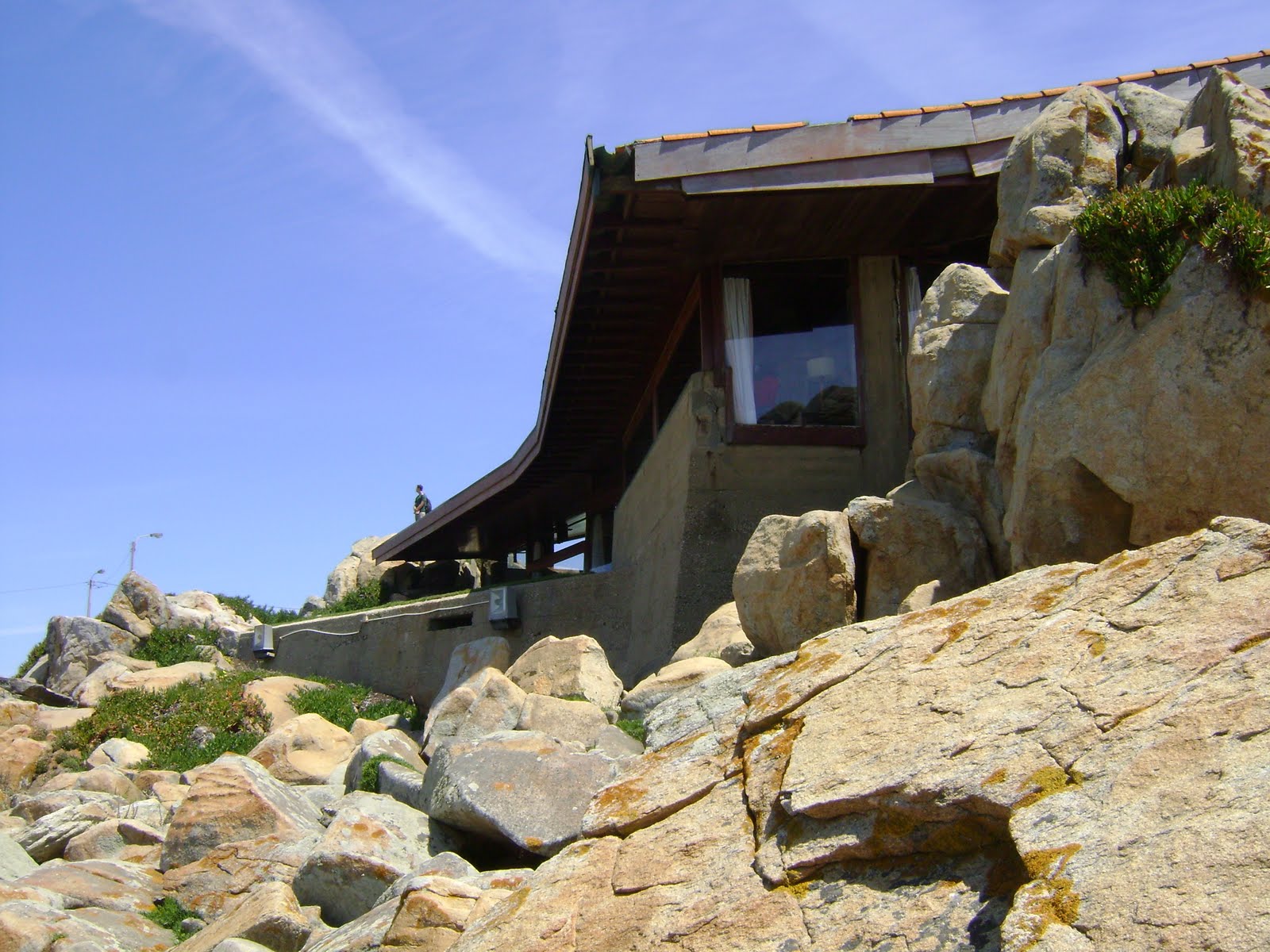
After meeting Begonia, Kate's friend from Spain at the station, we headed to a quick lunch under one of Porto's soaring bridges overlooking the river. On either side of this river, the hills of the city rise steeply, giving views of everything from the top. With class that day we visited a housing project by Siza, who is fabulous at creating very whimsical buildings-in this project for example, the handrails are shifted slightly off center making it look like someone made a mistake in the drawings. It was a Siza-filled day as our next stop was the atlantic coastline where Siza designed a set of pools and tea house fitted in among the rocky cliffs. The two projects were completely different-the pool house portion of the pool project was tucked away between the pedestrian walkway and beach while the tea house was set in jagged rocks, framing poscard picture views. We ate lunch at the bar next to bright blue waters and followed it with a climb to the top of the nearest rock pile. Our last stop of the day was Casa de Musica by Koolhaus-the cultural center of the city that houses one of the best shoebox theaters in the world and provides many musical workshops to all ages. The building itself is always open to the public and the public is allowed to roam its rooms freely, making the building an extension of the plaza just outside. A few of us went to a concert there later that night and the sound was fantastic-I don't think I even knew completely what accordians sounded like until then.
The next morning was also Siza-filled. We visited his School of Architecture and I have to say it was one of my favorite things weve seen thus far. Siza's whimsy was at its best, giving the architecture students there plenty to discover in their five or so years there. Materials wrapped in clever ways and the geometry of the spaces created fantastic optical illusions like one ramp that appeared to be sloping, even when standing on it but was actually completely flat. While in Porto we also made time to go to a port wine tasting, have some home cooked meals of octopus rice (slightly spicy and delicious) and check out the giant world cup screen set up in the middle of a public plaza.

Tuesday, June 15, 2010

Viva A Sardinha!


Arriving early evening in Merida, we quickly dropped our stuff and set out to explore the small town. I was drawn immediately to the riverside park which was simply landscaped but gave amazing views of the river, its many bridges and the mountains off in the distance. Not only that, but the entire town of Merida was out running, playing soccer, strolling, etc. in this park. It reminded me a lot of Riverside or Central Park in NY, only maybe a little less busy.
The next day we started class visiting the Migos Del Museo as well as many ancient Roman ruins, Merida having been a town started under the Roman Empire. Between the ruins and the Moorish mosaics on display in the museum, it was easy to forget we were in Spain.
Next stop, Portugal, where we arrived in Lisbon only to find out that very weekend was a local holiday celebrating one of the patron saints. And so, after an excellent dinner consisting of several varieties of very fresh fish (yes, mom and dad, you heard correctly, fish) we found ourselves in the midst of the equivalent of the entire city's party. Small winding streets were jam packed with people eating, drinking, dancing and just living it up. Severla conga lines later, we were ready to call it a night, to save some energy for the real party, which was saturday night. (The Portuguese certainly known how to have a good time.)
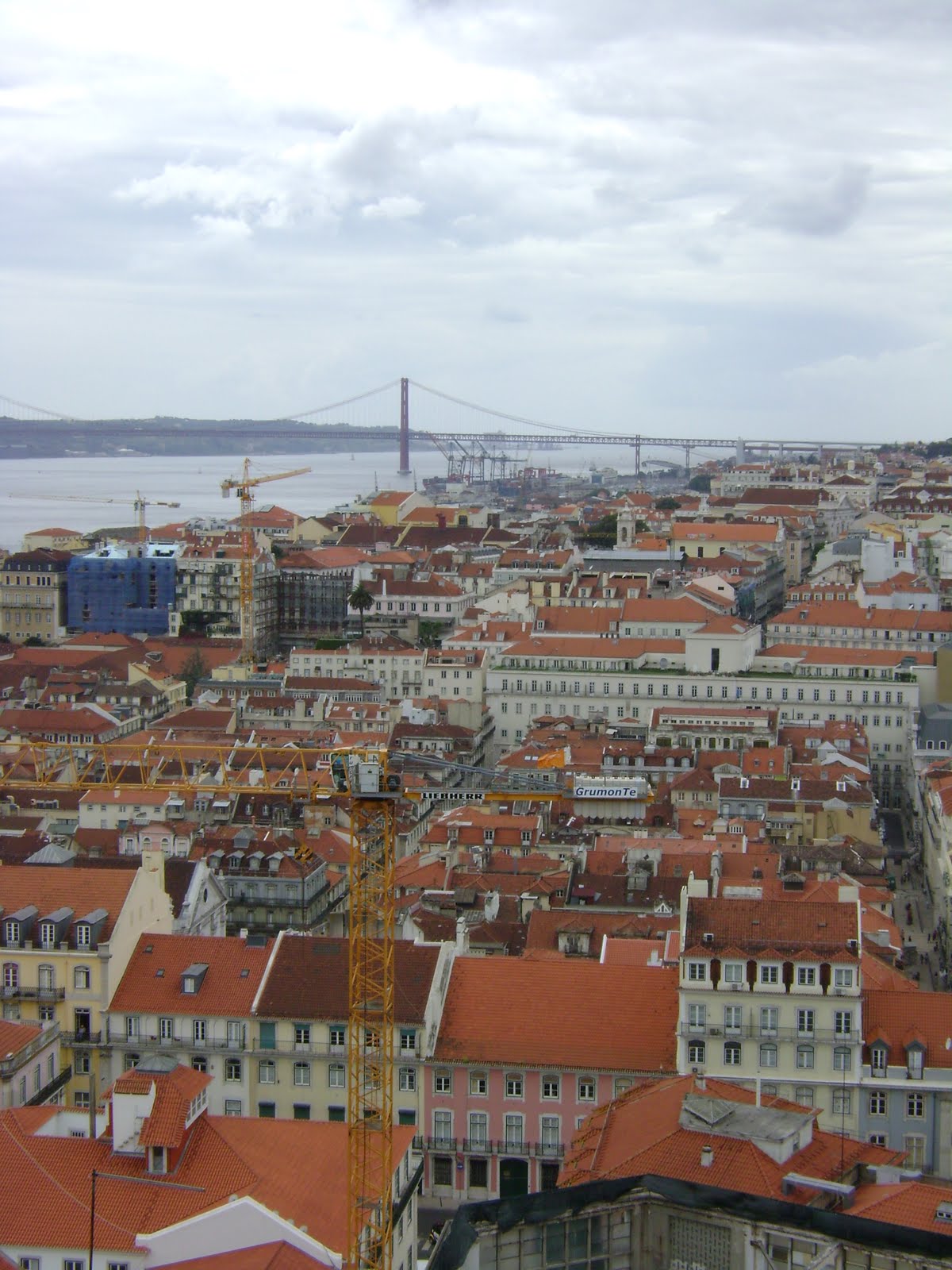
Class the next day consisted of walking and seeing as much of Lisbon as possible. Built on the mouth of the river running straight into the Atlantic, Lisbon is very much a port town. It is also built on a series of very steep hills, so they need a set of trolley cars to transport people up the hills-much like the ones in San Francisco. The Portuguese themselves seemed to be a completely different breed from the Spanish-obsessed with a good meal of the freshest fish, their passion for food reminded me a little of the French...
We visited the remains of a fortress on one of the hills, providing views of the entire city, an elevator designed, perhaps, by Eiffel, Calatrava's train station, and the Expo from '98 when Siza did many clever, playful buildings. This Expo was a lot more successful than that in Seville-located at the outskirts of the city, it became its own small town within Lisbon. At 7:30 we all raced back to the bar at the hostel to see the U.S. vs. England world cup match, which ended fairly well for the U.S. in a 1-1 tie. We did get a stupid goal, but overall I think played better than England and deserved the tie. The atmosphere at the hostel was perfect-game projected huge on a wall and people from all over all watching the game, beer in hand. The enemy was sitting at the next table, but wore friendly enough.
After the game, it was time to hit the streets for one of the biggest parties in Lisbon and boy was it packed-people of all ages were out well into the night and everywhere you looked there was music blasting, people dancing, and fresh sardines being grilled and smoked. In addition to the smoked sardines, there were churros, sangria, port wine, and ganga-a cherry flavored liquor all available for sampling for 1 euro apiece. Needless to say, we were sory to leave Lisbon early the next morning.